Sleep Cycle Time & Bedtime Chart: Best Times by Age
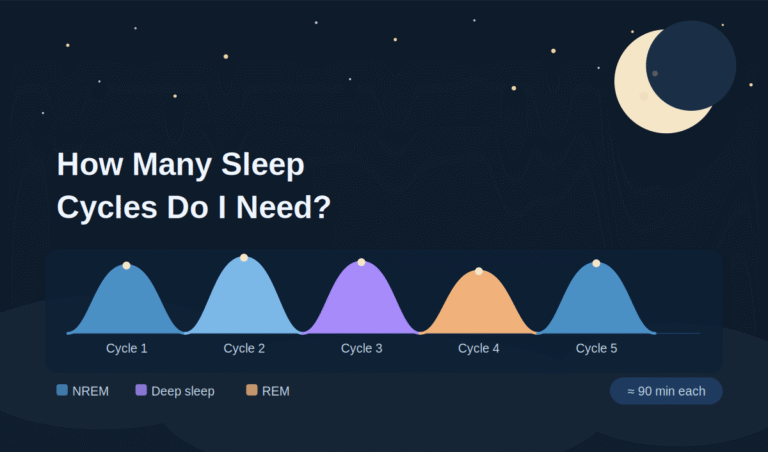
A bedtime chart turns sleep timing into a lookup instead of a math problem. Pick your wake-up time, read across, and you get the bedtimes that finish on a full 90-minute cycle — so your alarm lands at the end of a cycle instead of the middle of one. This page is built around the charts: a bedtime → wake-up table, a wake-up → bedtime table, and a by-age version so you can match the right number of cycles to who’s sleeping.
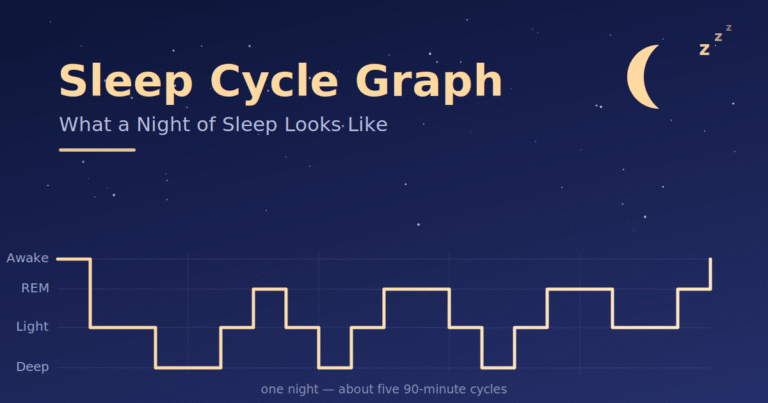
For the why behind the 90-minute number, see cycle length; to picture how a night of cycles actually looks, see the sleep cycle graph.
How to Read the Chart?
Every time in the tables below already includes about 15 minutes to fall asleep, so it’s the time you should be lying down with the lights off — not the time you need to already be asleep. Each step is one 90-minute cycle, and most people aim for the 5- or 6-cycle option on a normal night.
That’s the whole system: find your row, pick a cycle count, and set your alarm or your bedtime to the matching time.
Bedtime → Wake-up Time Chart
Already heading to bed? Find your bedtime on the left, then pick a wake-up time that ends on a full cycle.
| Bedtime | 4 cycles (6 hrs) | 5 cycles (7.5 hrs) | 6 cycles (9 hrs) |
|---|---|---|---|
| 9:00 PM | 3:15 AM | 4:45 AM | 6:15 AM |
| 9:30 PM | 3:45 AM | 5:15 AM | 6:45 AM |
| 10:00 PM | 4:15 AM | 5:45 AM | 7:15 AM |
| 10:30 PM | 4:45 AM | 6:15 AM | 7:45 AM |
| 11:00 PM | 5:15 AM | 6:45 AM | 8:15 AM |
| 11:30 PM | 5:45 AM | 7:15 AM | 8:45 AM |
| 12:00 AM | 6:15 AM | 7:45 AM | 9:15 AM |
| 12:30 AM | 6:45 AM | 8:15 AM | 9:45 AM |
| 1:00 AM | 7:15 AM | 8:45 AM | 10:15 AM |
For most adults, the 5-cycle column is the everyday target, with 6 cycles on nights you can get to bed earlier.
Wake-up Time → Bedtime Chart
Got a fixed alarm? Work the other way. Find the time you need to be up, then read across for the bedtime that lands you there on a clean cycle.
| Wake-up time | 6 cycles (9 hrs) | 5 cycles (7.5 hrs) | 4 cycles (6 hrs) |
|---|---|---|---|
| 5:00 AM | 7:45 PM | 9:15 PM | 10:45 PM |
| 5:30 AM | 8:15 PM | 9:45 PM | 11:15 PM |
| 6:00 AM | 8:45 PM | 10:15 PM | 11:45 PM |
| 6:30 AM | 9:15 PM | 10:45 PM | 12:15 AM |
| 7:00 AM | 9:45 PM | 11:15 PM | 12:45 AM |
| 7:30 AM | 10:15 PM | 11:45 PM | 1:15 AM |
| 8:00 AM | 10:45 PM | 12:15 AM | 1:45 AM |
So for a 6:00 AM alarm, go to bed at 10:15 PM for 5 cycles, or 8:45 PM for a full 6.
Bedtime Chart by Age
How many cycles to aim for shifts with age, mostly because total sleep needs change. The chart below assumes a 6:30 AM wake-up (a typical school or work start) and works the bedtime back from the cycles each group fits. If your wake-up time is different, slide the whole window earlier or later by the same amount.
| Age group | Cycles to plan | Bedtime for a 6:30 AM wake-up |
|---|---|---|
| School age (6–12) | 6–7 | 7:15 – 8:45 PM |
| Teens (13–18) | 5–6 | 8:45 – 10:15 PM |
| Students (18–25) | 5–6 | 8:45 – 10:15 PM |
| Adults (26–64) | 5–6 | 8:45 – 10:15 PM |
| Older adults (65+) | 5 | 10:15 PM |
These are planning ranges, not strict targets — the point is to pick the cycle count that fits the window and finish on a clean cycle. If you want help deciding which number fits you, the cycle count guide walks through it.
Skip the Chart — Use the Calculator
The charts cover the common times, but if your wake-up or bedtime falls between rows, the sleep cycle calculator gives you the exact times in one tap, with the 15-minute buffer already built in. Putting a child to bed? The kids calculator does the same with age-appropriate windows.
Common Questions about Sleep Cycle Time
Why does the chart add 15 minutes? Because almost no one falls asleep the instant they lie down. The average is about 15 minutes, so the chart builds it in — the times shown are when to be in bed, not when to already be asleep.
My ideal time falls between two rows — what do I do? Round to the nearest cycle option. Being five minutes off won’t undo the benefit; landing mid-cycle is what you’re avoiding.
Which cycle count should I pick? Five cycles (7.5 hours) suit most weeknights. Use 6 when you can get to bed earlier, and 4 as a short-night floor rather than a routine.
Does the chart work for any wake-up time? Yes — the 90-minute step is the same regardless of the clock time. If your exact time isn’t listed, count in 90-minute jumps from the nearest row, or run it through the calculator.
Bottom line
A sleep cycle time and a bedtime chart do one thing well: it tells you the exact time to go to bed or set your alarm so you finish on a full 90-minute cycle. Find your row, pick 5 cycles for a normal night or 6 when you can manage an earlier start, and use the matching time — with the 15-minute fall-asleep buffer already counted in.
Round to the nearest cycle when your real-world time falls between rows, keep the same slot most days, and the timing stops being a nightly question. When a time isn’t on the chart, the sleep cycle calculator fills the gap in one tap.