How Many Sleep Cycles Per Night?
Fact-checked against the Sleep Foundation and the National Institutes of Health
Last updated 15th Aug’26
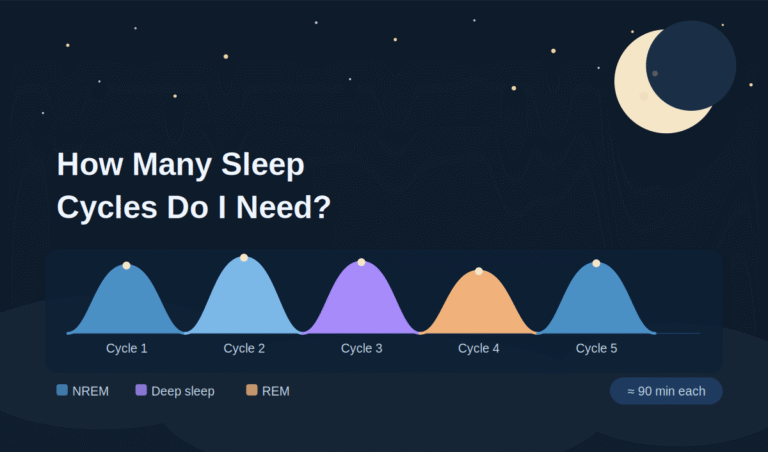
Most adults go through four to six sleep cycles per night. Because each cycle averages about 90 minutes, a full 7–9 hour night fits roughly five to six complete cycles, while a shorter 6-hour night covers about four. The exact number depends on how long you sleep and your own cycle length.
That single fact changes how you think about rest. The question isn’t really “how many hours did I get?” — it’s “how many full cycles did I finish?” Five complete cycles will usually leave you sharper than six broken ones.
This guide explains what a sleep cycle actually is, how many you get in a night, how cycles line up against total sleep time, and how the 90-minute rule works — everything you need to understand the structure before you plan around it.
When you’re ready to work out which number fits your own routine, the guide on finding your number walks through that step by step.
What is a Sleep Cycle?
A sleep cycle is one full pass through the phases of sleep — a single loop that lasts about 90 minutes from the moment you drift off to the point where the pattern resets and begins again.
It repeats throughout the night. You don’t sleep in one flat block. Instead, the same 90-minute loop runs over and over — four to six times for most people — until your alarm or your body ends the night.
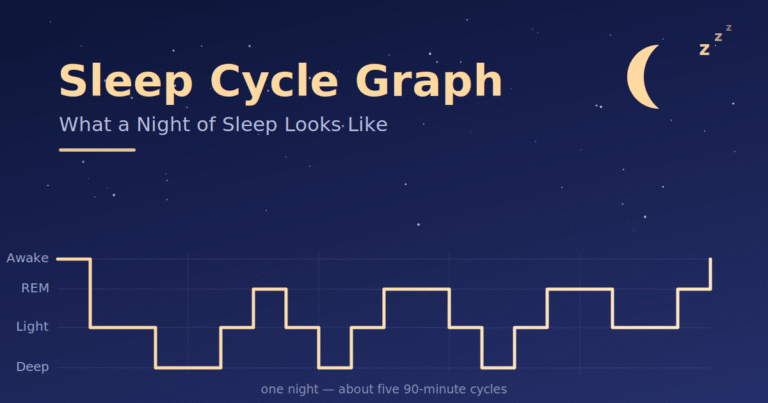
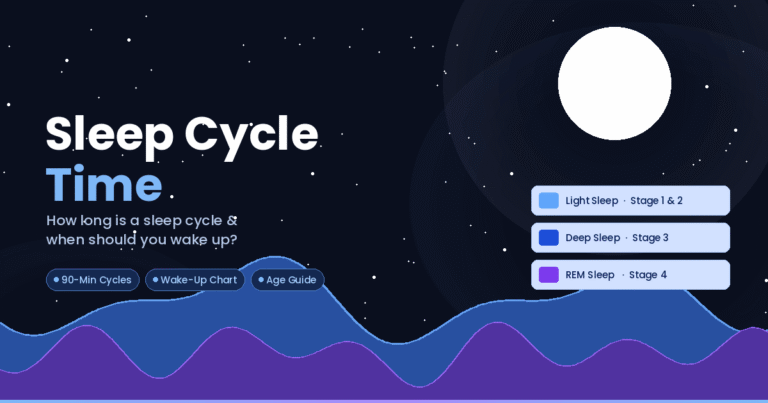
Each cycle follows a basic structure: light → deep → REM → reset. In plain terms:
- Light sleep opens the cycle. This is the easy-in, easy-out phase where you’re only loosely asleep and can be woken without much grogginess.
- Deep sleep comes next — the heaviest, hardest-to-wake stretch of the cycle. Being pulled out of this phase is what causes that thick, foggy feeling some mornings.
- REM is the dreaming phase, and it sits toward the end of the cycle.
- Reset — the cycle winds back down into a lighter phase and the next one begins.
The detail that matters most for timing: every cycle ends in a lighter phase. That light stretch at the close of each loop is the natural, easy moment to wake up — and it’s the whole reason cycle timing works at all.
How many cycles is a normal night?
A “night’s sleep” isn’t one long block — it’s a series of repeating cycles, and for most adults that means four to six per night, according to the National Institutes of Health. Each one runs about 90 minutes on average, so the number you complete comes down mostly to how many hours you’re actually asleep:
| Hours asleep | Approx. cycles |
|---|---|
| 6 hours | ~4 cycles |
| 7.5 hours | ~5 cycles |
| 9 hours | ~6 cycles |
This is different from how long one cycle lasts — here we’re counting how many fit into a whole night.
Why the Number isn’t Fixed?
Two people who both sleep eight hours won’t necessarily complete the same number of cycles. A few things shift it:
- Total sleep time. The single biggest factor — more hours asleep, more cycles.
- Cycle length. Cycles aren’t identical. Early-night cycles tend to be shorter and later ones longer, and personal cycle length varies from roughly 80 to 110 minutes.
- Age. Children run shorter cycles and complete more of them; cycle length settles toward the adult ~90 minutes by adolescence.
The Night isn’t Evenly Balanced
The cycles you complete aren’t interchangeable. Per the Sleep Foundation, deep sleep (N3) is concentrated in the first few cycles of the night, while REM (dream) sleep gets longer with each cycle and dominates the final ones before you wake. That’s why cutting a night short doesn’t just trim cycles evenly — it disproportionately removes the REM-heavy cycles at the end.
Sleep Cycles vs Total Sleep Time
Because each cycle is roughly an hour and a half, the math is clean — every cycle you add is another 90 minutes of sleep:
| Total Sleep | Sleep Cycles |
|---|---|
| 6 hours | 4 cycles |
| 7.5 hours | 5 cycles |
| 9 hours | 6 cycles |
This is also why a flat 8 hours can feel worse than 7.5 or 9. Eight hours doesn’t divide evenly into 90-minute blocks — it lands you a little over five cycles, which means your alarm goes off mid-cycle. Seven and a half hours (five clean cycles) or nine hours (six clean cycles) finish on the edge of a cycle instead, which tends to feel smoother even though one of those is less total sleep.
Why Sleep is Often Grouped into Cycles?
If you’ve ever wondered why sleep gets described in cycles rather than just hours, it comes down to three things:
Sleep runs in repeating blocks. Your night isn’t one long, uniform stretch — it’s the same loop repeating, each one moving from light into deep and through REM before starting over. Counting blocks describes what’s actually happening far better than counting raw hours.
Each block has a predictable length. The ~90-minute loop is consistent enough to plan around. That predictability is the key — if cycles were random lengths, timing your wake-up would be impossible.
Cycle timing helps you plan a schedule. Because each block ends in a lighter phase, knowing where the blocks fall lets you line up your wake-up time with the easy, natural exit point rather than the heavy middle of a cycle.
The 90-Minute Cycle Timing Rule
The 90-minute rule is the practical takeaway from everything above: sleep works in roughly 90-minute blocks, so plan your night in those blocks rather than in loose hours.
It works in either direction. You can count forward from when you go to bed to see when a cycle will naturally end, or count backwards from a fixed wake-up time to find the bedtimes that finish on a full cycle. Either way, you’re matching the clock to the rhythm of your sleep instead of fighting it.
One detail people miss: it takes the average person about 15 minutes to actually fall asleep, so your first cycle doesn’t start the instant your head hits the pillow. Any solid plan builds in that buffer — otherwise the timing slides 15 minutes off, and your alarm lands mid-cycle anyway.
That’s the concept. If you want to turn it into an actual bedtime — counting the blocks back from your own alarm, buffer included — the step-by-step is laid out on the find your cycle number guide, and our sleep cycle calculator does the whole thing for you in seconds.
Related reading
If you’re trying to decide which cycle count fits your own routine, the “Find Your Cycle Number” guide takes the rule above and applies it to your schedule and wake-up time. For exact clock times by age, the bedtime chart lays everything out at a glance, and if you want more on where the 90-minute figure comes from, the breakdown of cycle length digs into it. Heading to bed right now? The sleep now tool turns your current time into the next clean wake-up.
Are 4 cycles of sleep enough?
Occasionally, but not as a routine. Four cycles is about 6 hours, which sits below the 7–9 hours recommended for adults. It works as an emergency minimum — and if you’re that short on time, it’s better to wake at the end of the fourth cycle than partway into a fifth — but repeated four-cycle nights build up a sleep debt for most people.
How many sleep cycles do you get per night?
Most adults go through four to six cycles per night. Since each averages about 90 minutes, the number depends mainly on how long you sleep: roughly four cycles in a 6-hour night, five in 7.5 hours, and six in 9 hours.
What is the 10-3-2-1-0 sleep rule?
It’s a wind-down countdown for better sleep, with each number marking hours before bed: 10 hours before bed, no more caffeine; 3 hours before, no food or alcohol; 2 hours before, no work; 1 hour before, no screens; and 0 times hitting snooze in the morning. It started from a 2021 social-media post by Dr. Jess Andrade, a pediatrician and sports-medicine physician, and went viral on TikTok. It’s a memory aid for standard sleep-hygiene habits rather than a medical protocol.
Is 3 hours of REM sleep too much?
Not necessarily. REM normally makes up about 20–25% of a night’s sleep — roughly 1.5 to 2 hours across a typical 7–9 hour night — so 3 hours is on the high side but not automatically a problem. It can show up after sleep deprivation (your body catches up on REM), after cutting back on alcohol, or simply from an imprecise consumer sleep tracker, which often misjudges stages. Occasional high REM isn’t a concern on its own; a persistent, dramatic shift paired with feeling unrested is worth raising with a doctor.
How many sleep cycles are in 8 hours?
A little over 5. Eight hours doesn’t divide evenly into 90-minute blocks, so it leaves you mid-cycle — which is why 7.5 hours (5 cycles) or 9 hours (6 cycles) often feels cleaner than a flat 8.
Common Questions About: How Many Sleep Cycles Per Night?
How many sleep cycles are in 6 hours? Exactly 4. Six hours divides neatly into four 90-minute blocks, so it lands at the end of a cycle.
Is 5 sleep cycles normal? Yes — 5 cycles, about 7.5 hours, is the most common full-night pattern for adults and the number most people aim for.
How many sleep cycles do you have per night? Four to six for most adults, depending on how long you sleep. Five cycles is about 7.5 hours; six is about 9.
Do you complete the same cycles every night? No. The number and the makeup shift with total sleep time — deep sleep loads the early cycles, REM the later ones.
How long is one sleep cycle? About 90 minutes on average. For some people, a complete cycle runs closer to 80 minutes, and for others, past 100, but 90 is close enough to plan around.
Do sleep cycles get shorter during the night? Not really shorter, but the mix inside them shifts — earlier cycles lean toward deep sleep, and later ones carry longer, lighter phases. That’s part of why a wake-up that lands at the end of a later cycle tends to feel easy.
Wrapping up: Count Cycles, not Hours
So, how many sleep cycles per night? For most people, it’s 4 to 6, with 5 as the everyday pattern — about 7.5 hours. Each cycle runs roughly 90 minutes, repeats through the night, and ends in a lighter phase that’s the natural moment to wake.
The real shift is to stop thinking in flat hours and start thinking in whole cycles. Finishing your last full cycle is what separates a smooth wake-up from a groggy one, even when the total sleep is identical. Once that clicks, the planning is simple — and the sleep cycle calculator handles the counting so your wake time lands at the edge of a cycle instead of inside one.
References
- NIH / StatPearls — Physiology, Sleep Stages: https://www.ncbi.nlm.nih.gov/books/NBK526132/
- Sleep Foundation — Stages of Sleep: https://www.sleepfoundation.org/stages-of-sleep