If I Sleep Now, When Should I Wake-Up? (Free Calculator)
If you go to sleep now, the best time to wake up is in clean 90-minute steps, starting about 15 minutes from this moment. Counting from now, that usually lands you at 6 hours, 7.5 hours, or 9 hours of sleep. Wake up at the end of one of those steps instead of in the middle of one, and you get up feeling far less groggy.
This guide answers the exact question — if I go to sleep now, when should I wake up — in real clock times. You’ll get a sleep-now wake-up chart, a quick way to set your alarm, what to do if you can’t fall asleep in 15 minutes, and a simple sleep calculator method you can run in your head any time of day or night.
Use Our Sleep Now Calculator
If you go to sleep now, wake up at one of these times
It’s –:– now · asleep by about –:– ·
Each time lands at the end of a 90-minute sleep cycle, with 15 minutes to fall asleep built in. Aim for 5–6 cycles to wake up feeling your best.
Open the full Sleep Calculator →Want to wake at a set time, pick a different bedtime, or set your own cycle length? Use the full calculator.
Want more than just a “sleep now” answer? View our full Sleep Cycle Calculator — just enter the time you want to wake up or the time you’re going to bed, and it instantly shows your best matching times. It works out how much sleep you actually need across full 90-minute cycles, so you wake up between cycles instead of in the middle of one. Set your own bedtime, wake-up time, or cycle length, and let the calculator do all the counting for you.
How the “Sleep Now” Calculator Works
The math behind when will I wake up if I sleep now is short enough to do on your fingers:
- Start with the current time. That’s your “now.”
- Add 15 minutes. This is the average time it takes to actually fall asleep, so your real sleep clock starts a little after your head hits the pillow.
- Add 90 minutes for each cycle you want. Add 90 once for one cycle, 90 again for the next, and so on — up to 5 or 6 for a full night.
A quick example. Say it’s 11:00 PM right now:
- Fall asleep around 11:15 PM
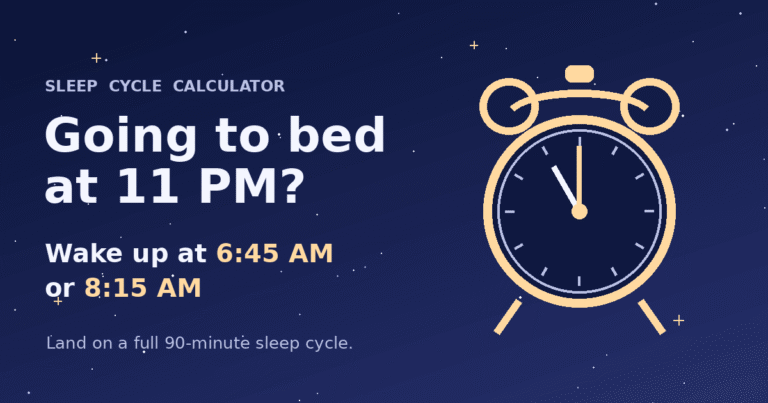
- 4 cycles (6 hrs) → wake at 5:15 AM
- 5 cycles (7.5 hrs) → wake at 6:45 AM
- 6 cycles (9 hrs) → wake at 8:15 AM
Because it’s all counted from “now,” this works at any hour. Going to bed at midnight, 1 AM, or even down for a long afternoon rest — the same count-forward steps give you the right wake-up time every time.
If You Go to Sleep Now, When Should You Wake Up?
The answer depends on one thing: the time right now. From that point, you add a short buffer to fall asleep, then count forward in 90-minute blocks. Each block is one full sleep cycle, and a good night is made up of 5 to 6 complete cycles.
So when you ask what time I should wake up if I sleep now, you’re really choosing how many cycles to fit in before your alarm:
- 4 cycles = about 6 hours of sleep
- 5 cycles = about 7.5 hours of sleep
- 6 cycles = about 9 hours of sleep
The trick is to aim for the end of a cycle. Waking up between cycles is what makes you feel refreshed; waking up in the middle of one is what leaves you reaching for the snooze button.
Sleep Now Wake-Up Time Chart
Here’s the part the question is really asking for: actual wake-up times. The chart below assumes it takes about 15 minutes to fall asleep, then counts forward in 90-minute cycles. Find the row closest to your current time, and the columns show when to set your alarm.
| If you fall asleep around (now) | Wake after 4 cycles (6 hrs) | Wake after 5 cycles (7.5 hrs) | Wake after 6 cycles (9 hrs) |
|---|---|---|---|
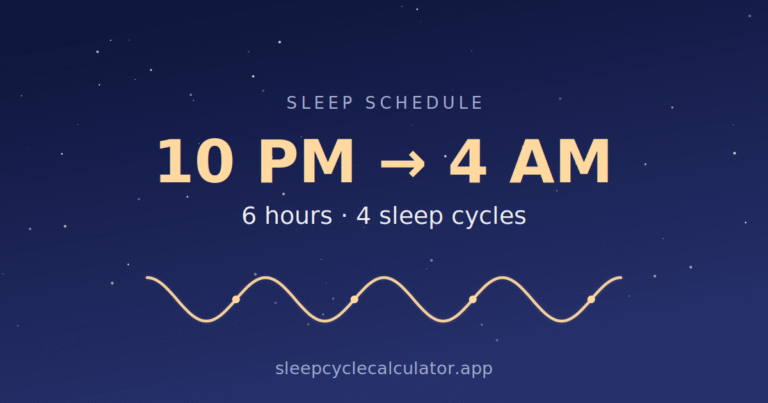
| 10:00 PM | 4:15 AM | 5:45 AM | 7:15 AM |
| 11:00 PM | 5:15 AM | 6:45 AM | 8:15 AM |
| 12:00 AM | 6:15 AM | 7:45 AM | 9:15 AM |
| 1:00 AM | 7:15 AM | 8:45 AM | 10:15 AM |
| 2:00 AM | 8:15 AM | 9:45 AM | 11:15 AM |
If your “now” isn’t on the chart, the next section shows the simple math so you can work out any time yourself.
Sleep Cycles to Hours: Quick Reference
Every wake-up time above comes from the same building block — the 90-minute cycle. This little table is the whole system in one place:
| Number of cycles | Total sleep time |
|---|---|
| 3 cycles | 4.5 hours |
| 4 cycles | 6 hours |
| 5 cycles | 7.5 hours |
| 6 cycles | 9 hours |
Most people feel best targeting 5 or 6 cycles. The 4-cycle option (6 hours) is there for nights when you’re heading to bed late and just want to wake up at a sensible point instead of mid-cycle.
What Time Should You Set Your Alarm If You Sleep Now?
Once you’ve picked your number of cycles, setting the alarm is the easy part — just use the wake-up time the chart or the math gives you. A few pointers to get it right:
- Pick the latest cycle you have time for. If you can fit 6 cycles before you need to be up, set the alarm there. If not, drop back to 5, then 4.
- Set the alarm for the cycle end, not a round number. A 6:45 AM alarm that lands between cycles beats a 7:00 AM alarm that cuts one in half.
- Give yourself the 15-minute buffer. The wake-up times already include it, so you don’t need to add extra — just go to bed when you say “now.”
What If You Can’t Fall Asleep in 15 Minutes?
The 15-minute buffer is an average, not a promise. Some nights you drift off in five minutes; other nights it takes longer. Here’s how to handle it without throwing the whole plan off:
- If you usually fall asleep faster, subtract a few minutes from the buffer. Asleep in about 5 minutes? Start your count 5 minutes after “now” instead of 15.
- If you usually take longer, add to the buffer. If it’s normally 30 minutes for you, count forward from 30 minutes after now.
- If you’re still wide awake after about 20 minutes, don’t lie there watching the clock. Reset your “now” to the new time and recalculate — your wake-up targets simply shift later by the same amount.
The point is that the buffer is adjustable. Once you know your own fall-asleep time, the calculator gets even more accurate.
What Time Should You Sleep to Wake Up at 6, 7, or 8 AM?
Sometimes the question flips: you already know when you have to get up, and you want the best bedtime. Same system, counted backwards instead of forward. The table below works back from a fixed wake-up time, including the 15-minute fall-asleep buffer.
| Wake-up time | Go to bed for 6 cycles (9 hrs) | Go to bed for 5 cycles (7.5 hrs) | Go to bed for 4 cycles (6 hrs) |
|---|---|---|---|
| 6:00 AM | 8:45 PM | 10:15 PM | 11:45 PM |
| 7:00 AM | 9:45 PM | 11:15 PM | 12:45 AM |
| 8:00 AM | 10:45 PM | 12:15 AM | 1:45 AM |
So if you want to wake at 7:00 AM feeling rested, getting to bed around 9:45 PM or 11:15 PM puts your alarm right between cycles.
How to Use the Sleep Cycle Calculator?
The calculator on this page does all of the counting for you, in two directions:
- Going to bed now? Choose the “Sleep Now” option, and it instantly shows your best wake-up times, counted forward from the current time with the fall-asleep buffer built in.
- Know your wake-up time? Enter it, and the tool counts backwards to show the best bedtimes.
Either way, you get a short list of times that land between cycles. Pick whichever fits your schedule, set your alarm, and you’re done — no math required.
Frequently Asked Questions
If I go to sleep now, when should I wake up? Add about 15 minutes to fall asleep, then count forward in 90-minute cycles. The best wake-up times are at the end of the 5th cycle (7.5 hours) or 6th cycle (9 hours) from now. Use the chart above for your exact current time.
What time will I wake up if I go to sleep now? It depends on the current time and how many cycles you want. From “now,” your refreshed wake-up options are roughly 6 hours, 7.5 hours, or 9 hours later, each landing at the end of a sleep cycle.
Is 10 pm to 7 am enough sleep? 10 PM to 7 AM is 9 hours of sleep, which is a full night for most people. Taking off the usual 15 minutes to fall asleep, that’s about 8 hours 45 minutes of actual sleep — right around 6 complete 90-minute cycles. Setting your alarm for 7 AM lands you neatly at the end of a cycle, so you wake up between cycles rather than in the middle of one.
If I sleep at 10 and wake up at 6, how many hours is that? That’s 8 hours of sleep — a solid full night that’s close to a clean cycle count.
Is 8 PM to 5 AM enough sleep? 8 PM to 5 AM is 9 hours, which is a full night for most adults and fits 6 complete sleep cycles.
What time should I sleep to wake up at 6 AM? To wake up at 6:00 AM, go to bed around 8:45 PM for 9 hours or 10:15 PM for 7.5 hours — both land your alarm between cycles.
Going to bed at a specific time instead of now? If you have a set bedtime like 7 PM, 8 PM, 10 PM, 11 PM, 12 AM, 1 AM, 2 AM, or 3 AM, each one has its own dedicated wake-up guide with a full chart for that exact time. Check the matching guide for your bedtime.
What is the 3-3-3 rule for sleep? It’s a quick checklist some people use to tell ordinary bad nights from a longer-running problem: poor sleep on at least 3 nights a week, lasting at least 3 months, affecting at least 3 parts of your day (like focus, energy, or mood). It isn’t a wake-up calculation — it’s just a memory aid for when ongoing sleep trouble might be worth raising with a professional.
How do I calculate my wake-up time? Take the current time, add 15 minutes to fall asleep, then add 90 minutes for each sleep cycle (up to 5 or 6). The result is your ideal wake-up time. The calculator does it for you instantly.
Conclusion
So, if you go to sleep now, when should you wake up? Add about 15 minutes to fall asleep, then count forward in 90-minute cycles, and aim to wake up at the end of the 5th or 6th cycle — usually 7.5 or 9 hours from now. Waking between cycles instead of inside one is the whole secret to getting up clear-headed instead of groggy.
Use the chart for a quick answer, the simple count-forward method for any time that isn’t listed, or the calculator above to do it all in one tap. Whatever time it is right now, you’re one short calculation away from the best wake-up time tonight.