If I Go to Bed at 11 PM, When Should I Wake Up?
If you go to bed at 11 PM, the best times to wake up are 6:45 AM or 8:15 AM. Set your alarm for either one and you’ll wake up just as a sleep cycle wraps up — which is exactly the sweet spot. 6:45 AM gives you five full cycles, and 8:15 AM gives you six.
Each sleep cycle lasts about 90 minutes, and waking up at the end of a full cycle helps you feel more refreshed. Waking up in the middle of a cycle can make you feel tired even if you slept long enough.
Below is a complete breakdown of your best wake-up times based on 11 PM with sleep durations.
Calculate Your Wake-Up Time From 11 PM
Bedtime set to 11 PM. Adjust how long you take to fall asleep.
This mini version is locked to an 11 PM bedtime. Want a different time, or to work backward from when you need to wake up? The full sleep cycle calculator handles both, fine-tunes the fall-asleep buffer, and maps every cycle the moment you enter a time.
Open the full calculator →The above calculator is set to an 11 PM bedtime. If you go to sleep at a different time, or you’d rather start from the hour you need to be awake, the full version does both. Enter any bedtime or wake-up time, and it maps out every sleep cycle instantly.
The 15-minute fall-asleep buffer is adjustable, too, so the times match how you actually drop off. Open the full sleep cycle calculator to run your own schedule.
11 PM Bedtime Wake-Up Times: Full Sleep Cycle Chart
A sleep cycle runs about 90 minutes. The idea behind setting your alarm to the end of one is simple: you wake up between cycles instead of in the middle of a long one.
Here is what an 11 PM bedtime looks like, cycle by cycle, with the 15-minute buffer built in.
| Cycles | Time asleep | Wake-up time |
|---|---|---|
| 1 cycle | 1.5 hours | 12:45 AM |
| 2 cycles | 3 hours | 2:15 AM |
| 3 cycles | 4.5 hours | 3:45 AM |
| 4 cycles | 6 hours | 5:15 AM |
| 5 cycles | 7.5 hours | 6:45 AM |
| 6 cycles | 9 hours | 8:15 AM |
The first few rows exist mostly for short naps or split schedules. For a normal night, the two rows worth setting an alarm to are five cycles (6:45 AM) and six cycles (8:15 AM). Those are the times you’ll see highlighted on the calculator, too.
Also, know about the 90-minute sleep cycle chart and how it works?
Sleep Cycle Breakdown from 11 PM
| Sleep Cycles | Wake-Up Time | Total Sleep | Feeling |
|---|---|---|---|
| 3 cycles | 3:30 AM | 4.5 hours | Very tired |
| 4 cycles | 5:00 AM | 6 hours | Low energy |
| 5 cycles | 6:30 AM | 7.5 hours | ⭐ Best balance |
| 6 cycles | 8:00 AM | 9 hours | Full recovery |
How is the 11 PM Wake-Up Time Calculated?
There are only two moving parts, and once you see them, the math is easy to do in your head.
First is the time it takes to fall asleep. Almost nobody is out the second their head hits the pillow, so the calculator adds a short cushion. Fifteen minutes is a sensible default for most people. If you know you tend to lie awake longer, add more; if you drop off the moment the lights are out, you can start the clock at 11 PM exactly and shift each wake-up time back by 15 minutes.
Second is the length of a cycle. Each one is counted as 90 minutes, so the wake-up times step forward in 90-minute jumps from the moment you fall asleep. Start at 11:15 PM, add 90 minutes, and you get 12:45 AM. Add another 90, and you get 2:15 AM, and so on down the table. That repeating pattern is the whole calculation.
Because the times are built on cycles rather than round hours, they rarely land neatly on the hour. A 6:45 AM alarm looks odd next to a tidy 7:00 AM, but the 6:45 figure is the one that sits at the end of a cycle. That small difference is the entire point of using a sleep cycle calculator instead of just guessing a round number.
Should You Wake Up at 6:45 AM or 8:15 AM?
It comes down to how much time you have before your morning starts.
If you need to be up and moving early, 6:45 AM is the natural choice. Five cycles is a full, normal night for most adults, and a 6:45 alarm gives you a reasonable head start on the day. If your morning is more relaxed, 8:15 AM stretches you to six cycles and a fuller night of sleep.
What you want to avoid is setting the alarm in the gaps between those rows. An alarm at 7:30 AM, for example, falls roughly in the middle of a cycle for an 11 PM bedtime, so you’re cutting a cycle short rather than letting it finish. If 7:30 is when you have to be up, you have two practical options: aim for the 6:45 AM mark and start your day a little earlier, or shift your bedtime instead so the cycle math lands closer to 7:30. The calculator handles either direction for you, so you don’t have to redo the sums by hand.
One more thing worth keeping in mind: the table is a guide, not a rule carved in stone. Cycle length and cycle count vary a little from person to person and night to night. The wake-up times give you a target to aim for, and after a few mornings, you’ll get a feel for which row suits you best.
Counting Hours Instead of Sleep Cycles
Sometimes you don’t care about cycles at all and just want to know how many hours an 11 PM bedtime gives you before a fixed alarm. That’s a straight clock calculation, with no fall-asleep buffer and no cycle rounding.
| Sleep until | Hours of sleep |
|---|---|
| 4:00 AM | 5 hours |
| 5:00 AM | 6 hours |
| 6:00 AM | 7 hours |
| 7:00 AM | 8 hours |
| 8:00 AM | 9 hours |
So 11 PM to 6 AM is exactly 7 hours, and 11 PM to 7 AM is 8 hours. Keep this separate from the cycle table above. The cycle times include the 15-minute cushion, while these hour totals are the literal difference between the two clock times. They answer two different questions, so it’s worth knowing which one you’re actually asking.
Wake-Up Times for Other Bedtimes
11 PM is one of the more common bedtimes, but the same cycle math works from any starting point. If 11 PM doesn’t match your schedule, the calculator covers every hour.
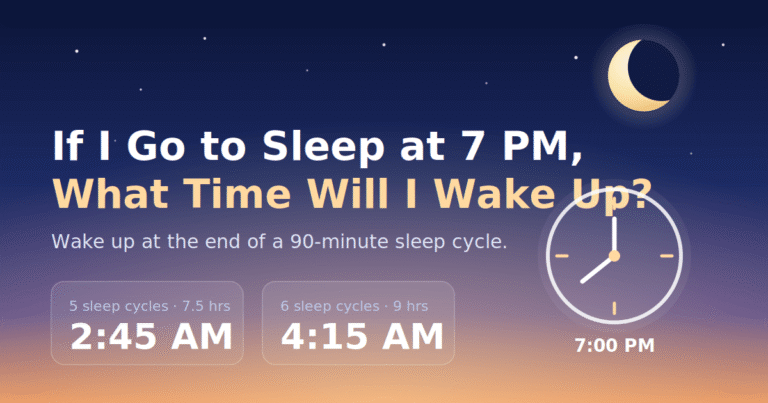
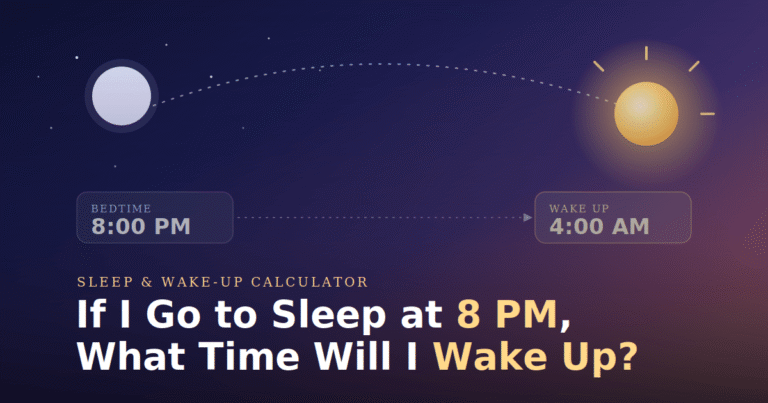
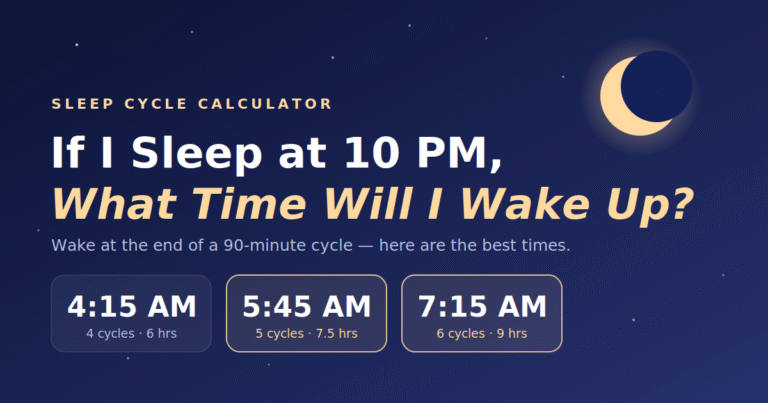
If you turn in earlier, the 10 PM bedtime page shifts every wake-up time back by an hour, with 5:45 AM and 7:15 AM as the two main marks. Earlier still, the 9 PM bedtime page is built the same way, and there’s a 7 PM bedtime page for very early nights or for working out nap timing.
The quickest route, though, is to skip the tables entirely and let the tool do it. Punch in your bedtime, and the sleep cycle calculator shows your wake-up times instantly, adjusts the fall-asleep buffer, and works in reverse too if you’d rather start from the time you need to be awake.
Frequently Asked Questions about 11 PM Bedtime
What time should I wake up if I go to bed at 11 PM? Aim for 6:45 AM or 8:15 AM. Those are the two times that fall at the end of a full sleep cycle, once you allow about 15 minutes to fall asleep. 6:45 AM is five cycles, and 8:15 AM is six.
How many sleep cycles are from 11 PM to 6:45 AM? Five. Counting from roughly 11:15 PM, five 90-minute cycles add up to 7.5 hours of sleep, which lands you at 6:45 AM.
How many hours of sleep is 11 PM to 6 AM? Seven hours, counting straight from clock to clock. This is the plain hour total and doesn’t include the fall-asleep buffer that the cycle times use, so it sits between the four-cycle and five-cycle marks.
Why aren’t the wake-up times on the hour? Because they’re spaced in 90-minute cycles, not in round hours. Starting from 11:15 PM and adding 90 minutes at a time gives you times like 6:45 and 8:15 rather than 7:00 or 8:00. Landing on a cycle boundary is the reason for the odd minutes.
What if it takes me longer than 15 minutes to fall asleep? Add the extra time to your starting point and push each wake-up time forward by the same amount. If you usually need 30 minutes, start the count at 11:30 PM, which moves 6:45 AM to 7:00 AM and 8:15 AM to 8:30 AM. The calculator lets you change the buffer so you don’t have to redo it manually.
Is it better to wake up at 6:45 AM or 8:15 AM after an 11 PM bedtime? Neither is “better” on its own; it depends on your morning. 6:45 AM gives you five cycles and an earlier start, while 8:15 AM gives you six cycles and a longer night. Pick whichever lines up with when you need to be up, and avoid the gap in between so you’re not cutting a cycle short.
What is the best wake-up time after 11 PM sleep? The best wake-up time is 6:30 AM, as it completes 5 sleep cycles.
Why do I feel tired after 8 hours of sleep? You may be waking up in the middle of a sleep cycle instead of at the end.
How many sleep cycles do I need? Most people need 4–6 full cycles per night.
Final Thoughts
For an 11 PM bedtime, set your alarm for 6:45 AM if you need an early start, or 8:15 AM if your morning is more relaxed. Both finish a full sleep cycle rather than cutting one short, which is the whole reason to work in cycles rather than a round number. The 15-minute fall-asleep buffer is the only thing nudging these times off the hour, so adjust it to match how quickly you actually drop off.
And if your bedtime moves, the math moves with it. Rather than redo the table by hand, let the sleep cycle calculator work out your wake-up times in a second.