How Long Is a Sleep Cycle? Sleep Length, Chart, and Free Calculator
A sleep cycle lasts about 90 minutes on average, but in practice it runs anywhere from roughly 80 to 110 minutes — shorter in the first cycles of the night and longer toward morning. Each cycle moves through four stages (N1, N2, N3, and REM), and a typical adult completes four to six cycles per night.
That single idea is what this whole page is built around. Below you’ll find the exact length of a sleep cycle, how many you need, a simple chart, and a sleep calculator that tells you the best time to go to bed or wake up. No complicated science, just the numbers you actually need.
Sleep Calculator: How Much Sleep Do You Need?
Sleep Cycle Calculator
When should you wake up?
Based on 90-minute cycles, plus 15 minutes to fall asleep.
Best wake-up times:
Tip: aim for the highlighted 5 or 6 cycle options. Waking at the end of a cycle helps you feel fresh instead of groggy.
Open the Full Sleep Cycle CalculatorWant your exact times in one tap? Skip the math — our free Sleep Cycle Calculator does it for you. Just enter when you want to sleep or wake up, and it instantly shows the best times to set your alarm around complete 90-minute cycles.
No sign-up, no guesswork. Try Sleep Calculator →
How long is One Sleep Cycle, really?
The number you’ll see everywhere is 90 minutes, and it’s a fair average — but it isn’t fixed. According to the National Institutes of Health, the body cycles through all sleep stages about four to six times a night, averaging roughly 90 minutes per cycle. In reality, the length drifts across the night: the earliest cycles tend to run shorter (around 70–100 minutes) and later ones stretch longer (about 90–120 minutes), as clinical sleep references note. So “90 minutes” is best treated as a working average, not a stopwatch.
That’s exactly why a sleep cycle calculator uses 90 minutes as its building block, adds about 15 minutes to fall asleep, and counts forward or backwards from there — it’s the most reliable single figure for most adults.
What Happens Inside Each Cycle
A cycle isn’t one continuous state — it’s a loop through four stages, and each one takes up a different share of the night. Per the Sleep Foundation and NIH:
- N1 (light sleep): the brief transition from awake to asleep, usually just 1–5 minutes. Only about 5% of the night.
- N2 (deeper light sleep): heart rate and temperature drop. This is where you spend the most time — close to half the night.
- N3 (deep sleep): the most restorative stage, concentrated in the first third of the night. Roughly a quarter of total sleep. This is the stage you least want to be woken from.
- REM (dream sleep): brain activity rises close to waking levels while the body stays still. REM makes up about a quarter of sleep and lengthens with each cycle, peaking toward morning.
One correction worth knowing, because a lot of sites get it wrong: modern sleep medicine recognizes four stages, not five. The American Academy of Sleep Medicine consolidated the old Stages 3 and 4 into a single deep-sleep stage, N3, so REM is its own phase — not “Stage 4.”
How Many Cycles Do You Get in a Night?
Most adults move through four to six full cycles per night (NIH). Five cycles works out to about 7.5 hours and six to about 9 — which lines up neatly with the 7–9 hours the Sleep Foundation recommends for adults.
Why Cycle Length Matters When You Wake Up
The stages aren’t equally easy to wake from. At the boundary between one cycle and the next, sleep is light and surfacing is smooth. Get pulled out of N3 deep sleep in the middle of a cycle and you hit sleep inertia — the groggy, foggy, slow-to-think feeling that commonly lasts 15–60 minutes and occasionally longer. Timing your alarm near a cycle boundary rather than mid-cycle is the whole point of counting in 90-minute blocks.
Does Cycle Length Change with Age?
Yes. Babies and young children run much shorter cycles — around 50–60 minutes — which is part of why they wake more often (research summary). The 90-minute average applies to adults; if you consistently wake groggy at cycle-aligned times, your personal cycle may run slightly shorter or longer, and shifting your bedtime 10–15 minutes can help.
Sleep Cycle Length by Age
Sleep cycle length isn’t the same for everyone. It changes as we grow, and it’s shortest when we’re very young. Here’s a simple overview (just the timing — no need to overthink it):
| Age group | Approximate sleep cycle length |
|---|---|
| Baby (newborn) | ~50–60 minutes |
| Toddler (around 2 years old) | ~60 minutes |
| Child | ~70–80 minutes |
| Teen (15–17 years old) | ~85–90 minutes |
| Adult | ~90 minutes |
The takeaway: younger sleepers have shorter cycles and wake more often, while teens and adults settle into the standard 90-minute cycle. If you’re calculating sleep for an adult or older teen, stick with 90 minutes.
Sleep Cycle Chart: Cycles to Hours
This chart is the fastest way to convert sleep cycles into hours. Keep it handy when you plan your bedtime.
| Sleep cycles | Total sleep time |
|---|---|
| 1 cycle | 1.5 hours |
| 2 cycles | 3 hours |
| 3 cycles | 4.5 hours |
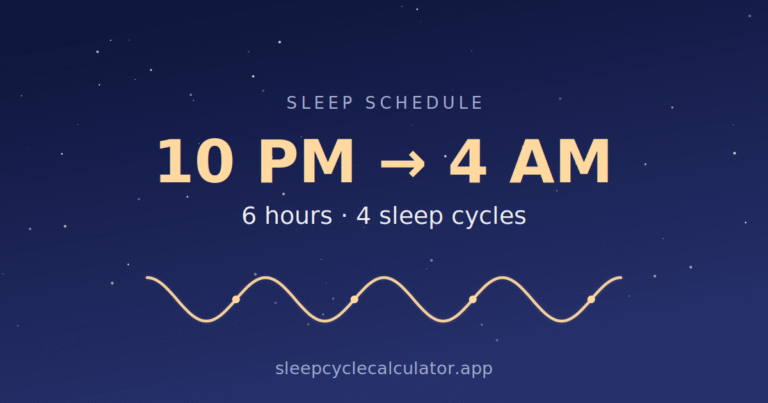
| 4 cycles | 6 hours |
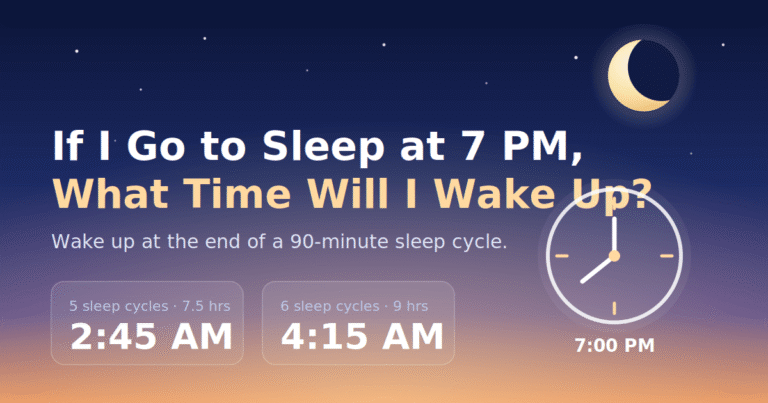
| 5 cycles | 7.5 hours |
| 6 cycles | 9 hours |
So 5 sleep cycles is 7.5 hours, and 6 sleep cycles is 9 hours — the two targets worth aiming for.
How to Calculate Sleep Cycles by Yourself?
Calculating sleep cycles is simple once you know the formula. There are only two numbers involved:
- 90 minutes for each sleep cycle.
- About 15 minutes to actually fall asleep after you get into bed.
So the full formula is:
Wake-up time = bedtime + 15 minutes + (90 minutes × number of cycles)
Most online sleep calculators quietly add that 15-minute “fall asleep” buffer without telling you — which is exactly why their times can feel slightly off if you ignore it. Counting it in is what makes your wake-up time land at the end of a cycle instead of partway through.
Want to do it backwards? To find your bedtime, start from your wake-up time and subtract the sleep time plus 15 minutes.
Best Times to Wake Up and Go to Bed
Once you know a cycle is about 90 minutes, turning that into real bedtimes and wake-up times is just counting blocks. Rather than repeat the full lookup tables here, you’ll find the complete bedtime → wake-up and wake-up → bedtime charts on the sleep cycle chart — and if you’re heading to sleep now, that tool gives you the next clean wake-up time in a tap. Either way, aim for the 5- or 6-cycle option so your alarm lands at the end of a cycle.
Quick Tip: Sleep Cycles and Naps
Naps follow the same 90-minute rule. A nap that lasts one full cycle (about 90 minutes) lets you wake up at the end of a cycle, so you avoid that heavy, foggy feeling. If you only have a short break, a 20-minute power nap works because it’s short enough to stop before deep sleep begins. The times to avoid are in between — a 45-minute nap often ends in the middle of deep sleep, which is why it can leave you feeling worse than before.
Is 3 hours a sleep cycle?
No — three hours is roughly two sleep cycles, not one. A single cycle averages about 90 minutes, so 180 minutes covers approximately two complete cycles. If you only have three hours to sleep, aim to wake near that two-cycle mark rather than partway into a third.
Do we sleep in 90-minute cycles?
Roughly, yes — but 90 minutes is an average, not a fixed rule. According to the NIH, adults cycle through all sleep stages four to six times a night, averaging about 90 minutes per cycle. In practice cycles run 80 to 110 minutes, shorter early in the night and longer toward morning.
What is the healthiest sleep cycle?
There’s no single “healthiest” cycle — what matters is completing enough full cycles and waking at the end of one rather than mid-cycle. For most adults that means five to six complete cycles, which lines up with the 7 to 9 hours the Sleep Foundation recommends, kept on a consistent daily schedule.
Are sleep cycles 45 minutes?
No — 45 minutes is only about half a cycle. A full adult sleep cycle averages around 90 minutes (80 to 110). The 45-minute figure is a common mix-up, usually confused with the length of a single sleep stage or a half-cycle, not a complete one.
Frequently Asked Questions
How long is a sleep cycle? About 90 minutes on average, ranging from roughly 80 to 110 minutes. Early-night cycles are shorter; later ones are longer.
Is every sleep cycle exactly 90 minutes? No. 90 minutes is an average. The first cycles can be closer to 70–100 minutes and later ones 90–120, and it varies from person to person.
How many sleep cycles are in a night? Four to six for most adults — about 7.5 hours at five cycles, 9 hours at six.
Why do I wake up groggy in the middle of a cycle? Waking from deep N3 sleep triggers sleep inertia — grogginess and slow thinking that can last 15–60 minutes. Waking near a cycle boundary avoids most of it.
Conclusion
So, how long is a sleep cycle? About 90 minutes, and you’ll go through 5 to 6 of them per night for a solid 7.5 to 9 hours of rest. The real win isn’t just sleeping more — it’s timing your alarm to land at the end of a cycle so you wake up clear-headed instead of groggy.
Use the sleep cycle chart and the calculator above to set your bedtime or your wake-up time. Remember to add that 15-minute buffer to fall asleep, and you’ll have a sleep schedule that works with your sleep cycles instead of against them.
References
- National Institutes of Health / StatPearls — Physiology, Sleep Stages: https://www.ncbi.nlm.nih.gov/books/NBK526132/
- Sleep Foundation — Stages of Sleep: https://www.sleepfoundation.org/stages-of-sleep