How Many Sleep Cycles Do I Need? Get the Right Sleep Cycle Number
Fact-checked against the Sleep Foundation and the National Institutes of Health
Last updated 15th Aug’26
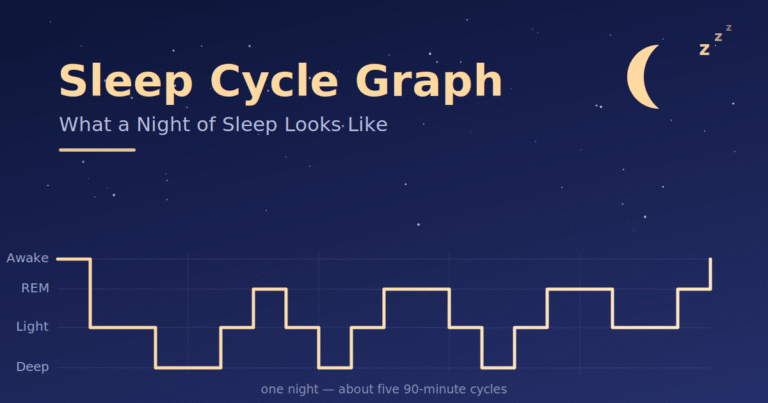
Most adults need five to six complete sleep cycles a night — about 7.5 to 9 hours of sleep. Five cycles (roughly 7.5 hours) is a solid target for a typical adult; six (around 9 hours) suits recovery from illness, heavy training, or catching up on sleep debt. Regularly getting fewer than four leaves most people under-rested.
This guide helps you land on your own number and build a bedtime routine around it. If you just want the mechanics of how a cycle works first, the per-night guide covers that.
How many do you actually need?
This is the target question — distinct from how many cycles a night usually contains. The Sleep Foundation recommends 7 to 9 hours of sleep for adults, and since a cycle averages about 90 minutes, that translates to roughly five to six complete cycles:
| Your goal | Cycles | Approx. sleep |
|---|---|---|
| Bare minimum (occasional) | 4 | ~6 hours |
| Solid target | 5 | ~7.5 hours |
| Full recovery | 6 | ~9 hours |
The aim isn’t to maximize cycles — it’s to complete whole ones and wake at the end of a cycle rather than the middle of one.
Why Whole Cycles Matter More than Raw Hours
Waking mid-cycle — especially out of deep N3 sleep — triggers sleep inertia, the groggy, slow-to-start feeling that can linger 15–60 minutes. Finishing a cycle and surfacing during lighter sleep sidesteps most of it. That’s the whole reason to plan around cycles: five clean cycles can leave you steadier than six interrupted ones. A sleep cycle calculator times your bedtime or alarm to those boundaries.
Does Everyone Need the Same Number?
No. The 7–9 hour range is a population guideline, and individuals sit at different points inside it. Some feel fully rested on five cycles; others need six. If you consistently wake tired at cycle-aligned times, nudging your sleep from five cycles to six — or shifting your bedtime 15 minutes — often closes the gap. Children and teenagers need more than adults.
Why Sleep Cycles are not the Same for Everyone?
Two people can both “need 5 cycles” on paper and still need completely different bedtimes. The cycle length is roughly the same for everyone — about 90 minutes — but everything around it changes from person to person.
Different daily routines. A day packed with early commitments leaves a narrower window than a slow, flexible one. Your routine sets the outer limits of how many cycles you can realistically fit.
Different schedules. A fixed 6 AM start and a rolling freelance schedule call for different cycle targets. One is locked; the other can flex to finish on a clean cycle.
Different wake-up times. Your wake-up time is the anchor everything else counts back from. Move it by an hour, and the bedtime that lands you on a full cycle moves with it.
Find Your Ideal Sleep Cycles
Here’s a quick way to match a cycle count to your situation:
4 cycles — a short schedule. Roughly 6 hours. This fits a tight night where sleep time is limited, and you mainly need your wake-up to land cleanly rather than to stretch the night out.
5 cycles — a standard daily routine. Roughly 7.5 hours. This is the most common setup and the one most people aim for on a normal day.
6 cycles — a long sleep window. Roughly 9 hours. This fits a schedule with a wide window and room for extra recovery time built into the night.
Sleep Cycles Based on Schedule Type
If you’d rather start from the kind of schedule you keep, use this as a starting point:
| Schedule Type | Recommended Cycles |
|---|---|
| Early riser | 4–5 |
| Standard routine | 5 |
| Late sleeper | 5–6 |
| Flexible schedule | 6 |
These are planning ranges, not rules. The point is to pick a target that fits the window your schedule gives you, then time your bedtime to finish on a full cycle.
Signs Your Sleep Schedule Doesn’t Fit Your Cycle Pattern
If your current bedtime and wake time aren’t lined up with your cycles, the schedule itself is usually the thing to adjust — not the number of hours. A few signs the fit is off:
Waking up feeling unbalanced. Some mornings feel fine, and others feel rough on the same number of hours, which usually means your wake time is landing at a different point in the cycle each day.
Mid-cycle wake-ups. Your alarm consistently pulls you out partway through a cycle instead of at the end of one, so you surface heavy instead of easy.
Inconsistent morning energy. Energy that swings day to day with no clear reason often traces back to a bedtime that doesn’t finish on a clean cycle.
How to Calculate Your Sleep Cycle Number?
You can work this out with one piece of arithmetic:
Use 90-minute blocks. Treat each cycle as a 90-minute block. Four blocks is 6 hours, five is 7.5, six is 9.
Start from your wake-up time. Your alarm is fixed first — that’s the anchor you count back from.
Adjust bedtime backwards. Count your chosen number of blocks back from your wake time, then add about 15 minutes for the time it takes to fall asleep. That’s the bedtime that finishes you on a full cycle.
A sleep cycle calculator runs this for you and builds in the 15-minute buffer automatically, so your wake time lands at the edge of a cycle instead of inside one.
Choosing the Right Cycle Count
Once you know how to count the blocks, two things decide which count to actually use:
Based on your available sleep window. Start with how much time you realistically have between tonight’s bedtime and tomorrow’s alarm. The window caps your options — there’s no point targeting 6 cycles on a night that only fits 5.
Based on daily routine consistency. If your routine is steady, lock one cycle count and keep the same wake time so it keeps working night after night. If your routine shifts, pick the count that fits each night’s window rather than forcing the same one every day.
Is 4 sleep cycles a night enough?
For most adults, not as a regular target. Four cycles is about 6 hours, which falls short of the 7–9 hours (five to six cycles) recommended for adults. It’s a reasonable emergency minimum when you genuinely can’t get more — and better ended cleanly at the fourth cycle than interrupted mid-fifth — but relying on it night after night leaves most people carrying a sleep debt.
How do I know how many sleep cycles I need?
Start from the adult recommendation of 7–9 hours — that’s five to six complete cycles — and use how you feel to fine-tune within it. If you wake groggy at cycle-aligned times on five cycles, try six. If you’re consistently alert and rested, five is likely your number. The reliable signal is waking without an alarm near the end of a cycle feeling refreshed; that’s your body showing you its target.
Is 10 PM to 4 AM enough sleep?
That’s 6 hours — about four sleep cycles — which is below the 7–9 hours most adults need. It’ll get you through occasionally, but as a routine it sits under the recommended range and tends to build a sleep debt. Pushing your wake time to 5:30 AM (7.5 hours, five cycles) or 7 AM (9 hours, six cycles) lands you inside the healthy range.
What is the 30-60-90 rule for sleep?
It’s a guide to nap length, based on which sleep stage you’ll wake from. A nap of about 30 minutes or less keeps you in light sleep for a quick refresh, a 60-minute nap reaches deep sleep and can aid memory but often leaves you groggy, and a 90-minute nap completes a full cycle so you wake more refreshed. The practical version is to keep naps to 30 minutes or extend to a full 90, avoiding the 30-to-60-minute “grogginess” window where you’re most likely to wake mid-deep-sleep.
How many sleep cycles do I need per night?
Most adults do best with five to six complete cycles — about 7.5 to 9 hours. Five is a reliable everyday target.
Is 5 sleep cycles enough?
For most adults, yes. Five cycles is roughly 7.5 hours, which sits inside the recommended 7–9 hour range.
Common Questions About: How Many Sleep Cycles Do I Need?
How do I know my sleep cycle number? Count 90-minute blocks back from your wake-up time and see how many fit your available window. The highest whole number of blocks that fits — usually 4, 5, or 6 — is your number for that night.
Should I use 4, 5, or 6 cycles? Five suits on most standard days. Use 4 when your window is short, and 6 when you have a long window and want extra recovery time built in.
What if my schedule changes daily? Pick the cycle count that fits each night’s window instead of forcing one fixed number. Keep your wake-up time as steady as you can, and let the bedtime move to finish on a full cycle.
Can I switch cycle numbers? Yes. Your cycle count is a planning target, not a fixed setting — you can move between 4, 5, and 6 as your schedule and available window change from one day to the next.
Related Readings
If you’re still getting your head around the basics, the per-night guide walks through how a full cycle is built and why the timing matters before you settle on a number. From there, the bedtime chart lays out the actual clock times for each cycle count by age, so you can see your target bedtime at a glance rather than working the math each night.
And if you’ve ever wondered why 90 minutes is the figure everything counts back from, the breakdown of cycle length explains where the number comes from. When you just need to get to bed right now, sleep now turns your current time into the next clean wake-up — and for younger sleepers, the kids calculator does the same with age-appropriate windows.
Conclusion
So, how many sleep cycles do I need? For most adults, the answer sits between 4 and 6, with 5 fitting a standard day — but your real number is the one that matches your own wake-up time and the window your schedule leaves you. Pick the count that fits tonight’s window, count 90-minute blocks back from your alarm, and add 15 minutes to fall asleep.
Once you know your number, the timing is the easy part. Keep your wake-up time steady, let your bedtime shift to finish on a full cycle, and your mornings stop swinging between “fine” and “rough” on the same hours. Use the sleep cycle calculator to do the counting for you and find the exact bedtime that lands you at the end of a cycle tonight.
References
- Sleep Foundation / National Sleep Foundation — How Much Sleep Do You Really Need: https://www.thensf.org/how-many-hours-of-sleep-do-you-really-need/
- NIH / StatPearls — Physiology, Sleep Stages: https://www.ncbi.nlm.nih.gov/books/NBK526132/