If I Sleep at 10 PM, When Should I Wake-Up?
If you go to sleep at 10 PM and take about 15 minutes to drift off, the best times to wake up are 4:15 AM, 5:45 AM, or 7:15 AM — each one falls at the end of a 90-minute sleep cycle, so you wake feeling refreshed instead of groggy.
For most adults, 5:45 AM or 7:15 AM is the ideal time to set an alarm. Use the quick calculator below to get your exact wake-up time, or read on for the full breakdown.
If I Go to Sleep at 10 PM, What Time Will I Wake-Up?
🌙 Sleep Cycle Wake-Up Calculator
Enter your bedtime to see the best times to wake up — at the end of a 90-minute cycle.
Want this for any bedtime? Our full Sleep Cycle Calculator does the math for you in one tap. Enter when you’re heading to bed (or hit “sleep now”) and instantly see every ideal wake-up time, each one lined up with the end of a 90-minute cycle so you wake up clear-headed instead of groggy.
No more counting hours on your fingers or guessing your alarm. It’s free, instant, and works for any schedule. Open the full Sleep Cycle Calculator →
The Quick Answer: Best Wake-Up Times for a 10 PM Bedtime
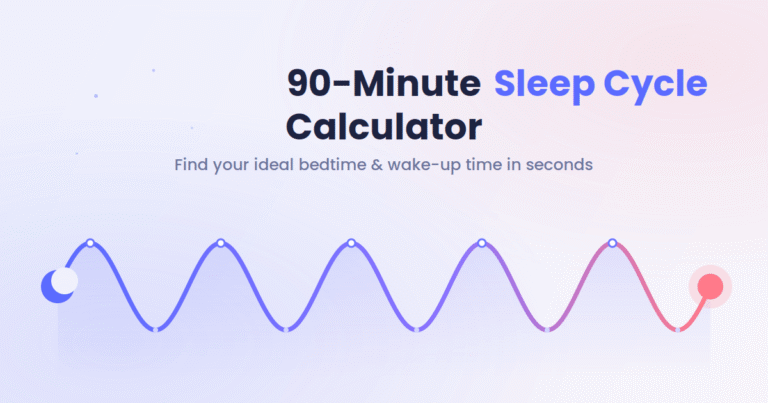
Sleep runs in cycles of roughly 90 minutes. Waking at the end of a cycle — rather than mid-way through deep sleep — is what makes getting up easy. So the real question isn’t only “how many hours,” it’s “which wake-up time lands on a cycle boundary.”
For a 10 PM bedtime (asleep around 10:15 PM), the cycle-aligned wake-up times are:
- 4:15 AM — 4 cycles, about 6 hours of sleep
- 5:45 AM — 5 cycles, about 7.5 hours (recommended)
- 7:15 AM — 6 cycles, about 9 hours (recommended)
If you want to feel your best, aim for 5 or 6 full cycles — that’s 5:45 AM or 7:15 AM, which lands in the 7-to-9-hour range most adults need.
How the 90-Minute Sleep Cycle Calculation Works?
Each night, you move through repeating stages of sleep: light sleep, deep sleep, and REM. One full cycle averages about 90 minutes, and a typical night is 4 to 6 cycles back to back. An alarm that goes off in the middle of a cycle pulls you out of deep sleep — that’s the heavy, groggy. An alarm timed to the end of a cycle catches you in lighter sleep, so waking is smoother.
Not sure how many cycles to aim for? Our guide to how many sleep cycles you need explains the right cycle number for your age.
Why do we add 15 minutes?
You almost never fall asleep the moment you lie down — the average is around 10 to 20 minutes. The calculation counts cycles from when you’re actually asleep, not when you got into bed, so it adds a 15-minute buffer by default. If you usually fall asleep faster or slower, adjust it in the calculator.
The simple math, step by step
- Start at 10:00 PM — the time you get into bed.
- Add about 15 minutes — now asleep at 10:15 PM.
- Add complete 90-minute cycles — 4, 5, or 6 of them.
- That’s your alarm — 4:15 AM, 5:45 AM, or 7:15 AM.
10 PM Wake-Up Times at a Glance
Reference chart for a 10 PM bedtime with a 15-minute fall-asleep buffer:
| Sleep cycles | Wake-up time | Total sleep | Best for |
|---|---|---|---|
| 3 cycles | 2:45 AM | ≈ 4.5 hours | Too short for most |
| 4 cycles | 4:15 AM | ≈ 6 hours | Light sleeper / early start |
| 5 cycles | 5:45 AM | ≈ 7.5 hours | Recommended |
| 6 cycles | 7:15 AM | ≈ 9 hours | Recommended |
These times shift if you change your bedtime or how long it takes you to fall asleep — use the calculator for your exact numbers.
How to Use the Wake-Up Calculator?
Keep 10:00 PM as your bedtime (or change it to your own), set how long you usually take to fall asleep, and read the results. Pick the wake-up time that gives you enough total sleep and fits your morning — most people choose 5:45 AM or 7:15 AM for a 10 PM bedtime. Set your alarm for that exact time so it lands at the end of a cycle.
Cycle length isn’t the same for everyone — see how it shifts by age in our sleep cycle time chart and graph.
Wake-Up Times for Other Bedtimes
Going to bed at a different time? The same 90-minute-cycle method works for any schedule:
- On an earlier schedule? Check what time you’d wake from an 8 PM bedtime.
- Not sure when to set your alarm tonight? Get an instant answer with If I Sleep Now, When Should I Wake Up?
- Want a specific 10 PM wake-up? See whether a 10 PM–6 AM night is enough — it’s 8 hours, and here’s how the cycles line up.
Or run any bedtime through the full Sleep Cycle Calculator for instant results.
Frequently Asked Questions about 10 PM Bedtime
Is 10 PM to 5 AM enough sleep?
10 PM to 5 AM is 7 hours in bed. After the ~15 minutes it takes to fall asleep, that’s about 6 hours 45 minutes of actual sleep — roughly 4.5 cycles, so a 5 AM alarm catches you mid-cycle. For a clean 5 cycles, set your alarm for 5:45 AM instead.
What time should I wake up if I slept at 10 PM?
Asleep around 10:15 PM, the cycle-aligned wake-up times are:
- 4:15 AM (4 cycles, ~6 hours)
- 5:45 AM (5 cycles, ~7.5 hours — recommended)
- 7:15 AM (6 cycles, ~9 hours — recommended)
Can I sleep at 10 PM and wake up at 4 AM?
Yes. A 4:15 AM alarm completes 4 full 90-minute cycles (about 6 hours) and lands at the end of a cycle, so you wake in light sleep. It’s a short night — fine for an early start, not ideal as a daily routine.
Is sleeping at 10 PM good?
For cycle timing, 10 PM is a convenient bedtime because it lines up neatly with common wake-up times: 4:15 AM (4 cycles), 5:45 AM (5 cycles), or 7:15 AM (6 cycles). Pick the one that gives you enough total sleep and fits your morning.
Is 6 AM a good wake-up time after a 10 PM bedtime?
A 6:00 AM alarm falls just after the end of your 5th cycle (5:45 AM), so you wake in light sleep rather than deep — close to a clean boundary and far easier than a mid-cycle wake-up. To land exactly on a cycle, 5:45 AM or 7:15 AM is ideal. (If you just want the total hours 10 PM to 6 AM adds up to, that’s a duration question rather than a cycle one.)
Is it better to wake up at 4 AM or 7 AM after a 10 PM bedtime?
Both 4:15 AM and 7:15 AM fall at the end of a cycle, so neither leaves you mid-cycle. The difference is total sleep: 4:15 AM gives ~6 hours, 7:15 AM gives ~9 hours. 7:15 AM is closer to the 7–9 hours most adults need.
Conclusion
If you go to sleep at 10 PM, the best time to wake up is 5:45 AM or 7:15 AM — the end of your 5th or 6th 90-minute sleep cycle — with 4:15 AM as a shorter 6-hour option. The trick is simple: count complete 90-minute cycles from the moment you actually fall asleep (about 15 minutes after getting into bed), and set your alarm for the end of a cycle rather than the middle of one.
Do that, and you’ll wake up clear-headed. Use the sleep calculator to fine-tune the times to your own bedtime and how long you take to fall asleep, then set your alarm and let your sleep cycles do the rest.
Note: sleep-cycle length is an average (~90 minutes) and varies from person to person and night to night. Use these times as a helpful estimate, not an exact prescription.